

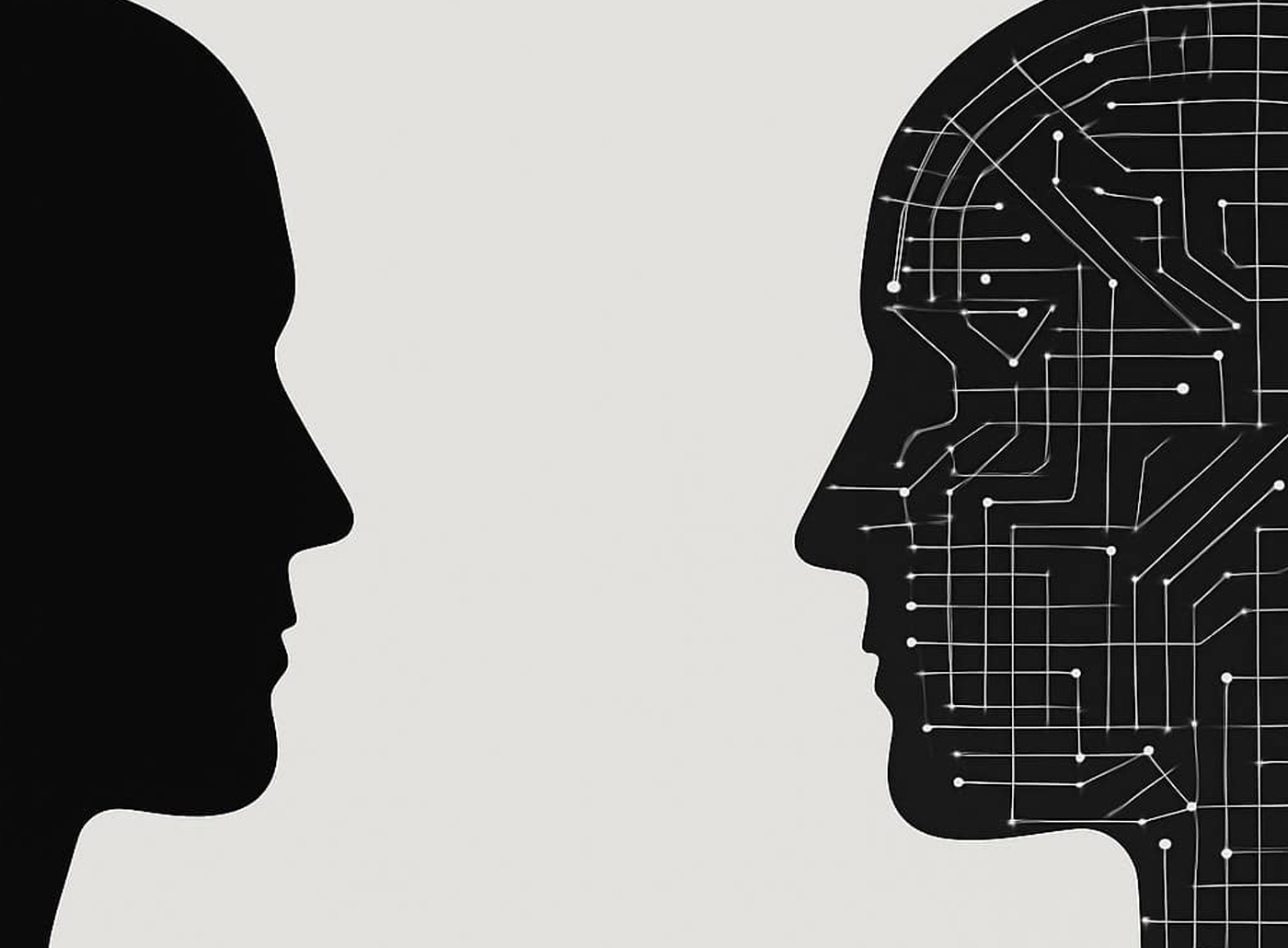
Understanding vs. Mimicry: What Does AI Really Know?
Artificial intelligence has become astonishingly capable. It writes poetry, tells stories, debates moral dilemmas, and can even offer what sounds like empathy in a conversation. But beneath the surface of these feats lies a deeper question: Is AI truly intelligent, or does it only mimic intelligence?
As generative systems grow more persuasive, the line between simulation and understanding seems to become thin. We’re entering a time when our instinct to humanise machines – to hear meaning where there may be none – could shape everything from creative industries to leadership decisions. Understanding what’s real in AI behaviour, and what’s simply an echo of our own humanity, is both a philosophical curiosity and a civic necessity.
What Does AI Really “Know”?
When an AI model answers a question, writes a story, or offers sympathy, it can feel like it understands us. But does it? Or is it simply performing a statistical trick – an intricate form of mimicry that looks, sounds, and behaves like comprehension?
At the heart of this question lies the architecture that powers today’s large language models (LLMs). These systems don’t hold meanings in the way we do. They don’t have memories, beliefs, or internal concepts. Instead, they operate within an enormous mathematical landscape – a high-dimensional space where every word, phrase, or idea is represented as a point or vector.
Through training on vast amounts of text, the model learns the relationships between these points: how likely one word is to follow another, how clusters of words tend to appear together, and which sequences seem coherent. When we type a question, the model searches this multidimensional map, calculating the most probable continuation of the sequence. What emerges is remarkably convincing language – but it’s built on correlation, not cognition.
To put it simply, an LLM doesn’t know what the word “tree” means; it knows how “tree” behaves in the company of “forest,” “shade,” or “roots.” It can describe trees, write poetry about them, even invent metaphors – yet there is no sensory experience of bark or leaf, no mental image, no understanding of the thing itself.
The Illusion of Comprehension
The fascination lies in how language, when statistically well-modelled, can so effectively suggest comprehension without possessing it. Human’s are natural storytellers, evolved to seek agency and intention in what’s around us. When an AI writes fluently or responds with emotional phrasing, our instinct is to project understanding onto it.
But the fluency of language and the presence of understanding are not the same thing. The brilliance of modern AI lies in how finely it blurs this line – giving us a mirror that reflects not its own mind, but ours.
Why This Distinction Matters
As AI systems move from tools to collaborators – writing legal briefs, designing buildings, diagnosing illnesses – the question of understanding becomes more than philosophical. It becomes ethical, professional, even existential. If machines can convincingly mimic empathy or insight, how do we ensure that we, the humans in the loop, remain capable of recognising the difference? What problems arise when humans fail to recognise the difference between genuine understanding and statistical imitation?