A Sustainability Workshop
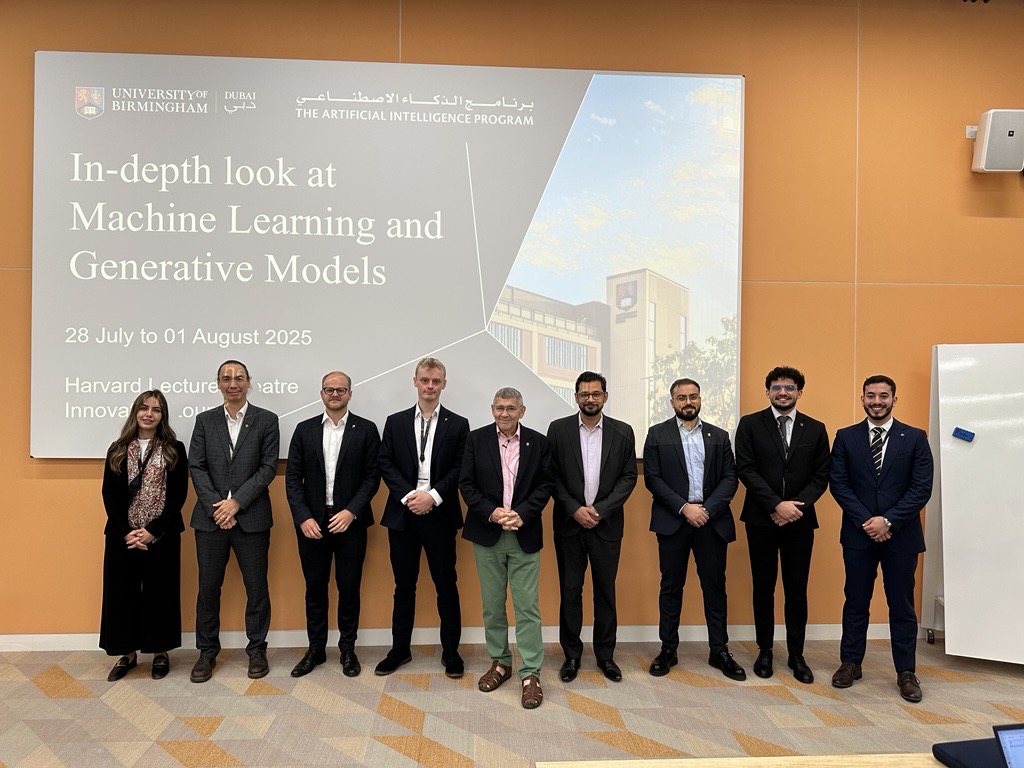
Last week, our team from the Oxford Centre for Artificial Intelligence was in Dubai, delivering a hands-on AI and Sustainability workshop as part of the National AI Programme. Hosted in collaboration with the AI Office and the University of Birmingham Dubai, the workshop brought together a diverse cohort of delegates committed to exploring the intersection of AI innovation and environmental responsibility.
Workshop Focus: Carbon Emissions, Water Use, and LLM Choice
Participants engaged with real-world case studies and current data to examine:
- The energy and water costs associated with different AI model sizes.
- Trade-offs between accuracy, speed, and environmental impact.
- Emerging best practices for sustainable AI model deployment.
Gamified, Group-Based Learning
To make the session both engaging and impactful, we adopted a gamified, team-based format. Delegates were grouped into “tech teams” tasked with selecting a suitable AI model to deploy. Scenarios range from climate forecasting to customer service automation, factoring in carbon emissions, water usage, and organisational priorities.
Teams were provided with emissions calculators, scenario briefs, and environmental impact data to simulate the kind of real-time decisions AI practitioners must increasingly make.
The interactive format sparked lively discussion, and critical thinking. The combination of technical insight and real-world application helped bridge the gap between theory and practice, making complex sustainability issues tangible and actionable.
Outcomes and Reflections
The workshop was well received by participants, with positive feedback highlighting:
- Awareness of the environmental impacts of LLMs.
- Actionable strategies for reducing AI-related emissions.
- Valuable discussions and team building, referencing examples from different organisational contexts (outside the course).
One delegate noted,
“This was the first time I’ve thought of AI deployment as a sustainability issue. The workshop made it clear we all have a role to play in responsible AI development.”
Sustainability is no longer a peripheral concern in AI development, it is central to building trustworthy and equitable systems.
We look forward to continuing our work with partners and delegates to ensure that AI can be both powerful and sustainable.